
Breastfeeding: finding your rhythm
Recognising feeding cues, getting comfortable and knowing what is worth recording.
 Feeding
The essentials
- Watch your baby as well as the clock.
- Comfort, attachment and swallowing matter more than a timer total.
- Ask for feeding support early if something feels difficult.
Learn the early feeding cues
It takes time to recognise what your own baby is telling you. A turning head, an opening mouth or a hand moving towards the mouth can be an invitation to offer a feed. Crying can come later, when settling and attaching may be more difficult. You do not have to wait for a certain number of minutes to pass before responding.
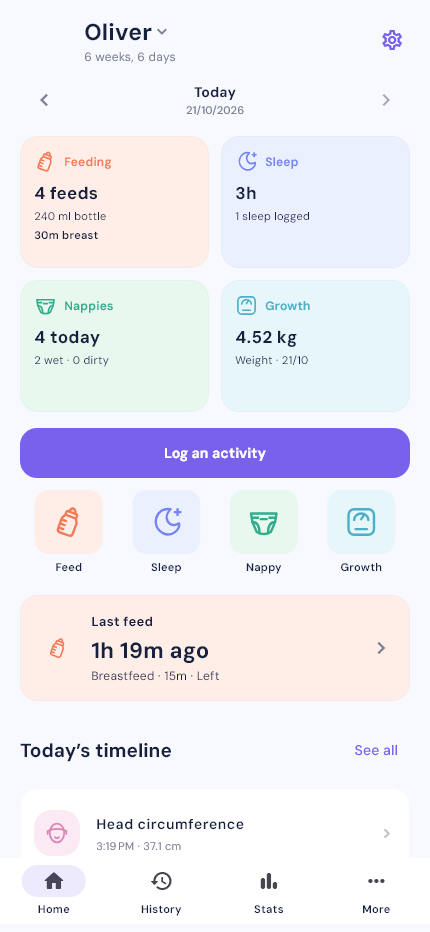
A log can answer ‘which side did we start with?’ while you concentrate on your baby. Use it as a memory aid alongside the feeding plan your maternity team gives you, especially if your baby needs help waking or has additional feeding needs.
Further guidance: Pregnancy, Birth and Baby: Breastfeeding your baby
Make yourself comfortable first
Bring water and anything you need within reach before settling down. Support your back and arms, and bring your baby close rather than leaning forwards for a whole feed. There is more than one breastfeeding position; the one that works for a friend may not be the one that feels comfortable for you.
Persistent pain, damaged nipples or repeated difficulty attaching deserve practical help. A midwife, lactation consultant or child health nurse can watch a feed and help you adjust positioning. You are not expected to work everything out from a written description.
Further guidance: Pregnancy, Birth and Baby: Breastfeeding your baby
Understand what the timer can tell you
Time at the breast is different from the amount of milk transferred. Babies may suck, pause, swallow and rest during a feed, and the pattern can change. Ten minutes on one day is not automatically equivalent to ten minutes on another. A short feed cannot be judged in isolation.
If you use a timer, record the side and stop it when the feed ends. In Baby Tracker you can pause for an interruption or enter a feed afterwards. There is no need to restart a finished feed just to make its duration resemble yesterday's.
Further guidance: NHS: Breastfeeding — the first few days · NHS: Is my baby getting enough milk?
Keep a small, useful record
Choose a recording habit you can maintain when you are tired. Start time, side and duration are usually easier to look back through than a long description of every movement. Optional notes are useful when there is a specific question you want to discuss later.
For example, ‘started left; stopped timer late’ explains an unusually long entry without suggesting your baby fed continuously. If another caregiver is helping, agree who saves the entry so that the same feed does not appear twice. Missing a timer is not a failure; an approximate manual entry can still be useful.
Expect the rhythm to move around
Early feeds can be close together, and the pattern may shift as you and your baby get used to breastfeeding. A busy evening of feeds does not need to become the template for every evening. Follow individual professional advice rather than trying to stretch a gap to match an online routine.
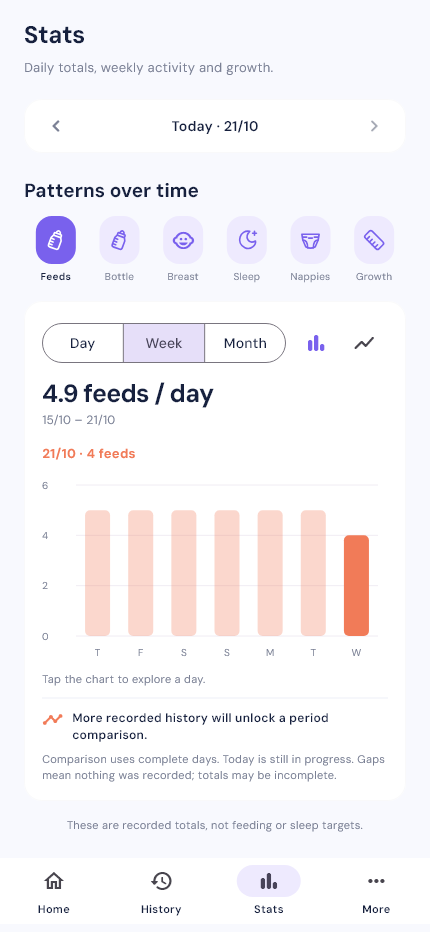
When reviewing a week, separate observations from assumptions. ‘More feeds were recorded on Tuesday’ is an observation. ‘There was not enough milk’ is a conclusion a timer cannot establish. Keeping that distinction makes your records more useful at appointments.
Further guidance: NHS: Breastfeeding — the first few days
Bring the right questions to your support team
If you are worried about intake, describe feeding alongside wet nappies, how your baby seems and any recorded weights. A professional can put those details together and, if needed, observe a feed. Do not wait for a complete week of data before getting help.
You might ask: ‘Can you watch the attachment?’, ‘What signs should I look for during a feed?’ or ‘What should I do if my baby is too sleepy to feed?’ Write down the plan you are given so everyone caring for your baby understands it.
Further guidance: NHS: Is my baby getting enough milk?
Sources & further reading
For the full guidance and advice for your circumstances, start with your local healthcare team and these resources.
NHS: Breastfeeding — the first few daysPregnancy, Birth and Baby: Breastfeeding your babyNHS: Is my baby getting enough milk?General information only. This site and app do not diagnose, treat or monitor medical conditions. If your baby seems unwell, seek medical advice rather than waiting to collect more records.
A little more to explore
Bottle feeding, one feed at a time
Responsive feeding, safe preparation and a clear record of the milk your baby actually takes.
Read guideUnderstanding changing feeding patterns
Read a feeding history with more confidence, without turning every change into a conclusion.
Read guide